Showing posts with label Orff. Show all posts

Friday, March 11, 2016

A Bucket and Some Boomwhackers

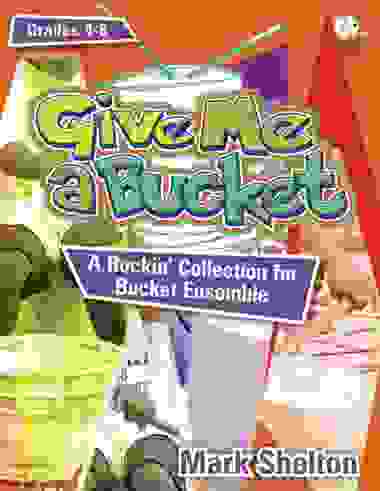
In this video, Mark Shelton plays an excerpt of "Strange Asparagus" from his popular collection, Give Me a Bucket. Enjoy!


Give Me a Bucket

Grades 4–8 • Music education meets the vibrant energy of street musicians in this accessible collection for bucket ensemble. Mark Shelton brings you a dozen arrangements utilizing buckets, pails, and drumsticks. In addition to guiding you through the process of setting up your bucket ensemble, this collection includes teaching and performance tips, some simple choreography, and performance tracks.

To order or for more information, visit www.lorenz.com

_________________________________________________

Mark Shelton has presented hundreds of arts-in-education performances as a percussion soloist and as leader of the world music ensemble, Tin Roof Tango. From the early days of his career as Visiting Artist at Coastal Carolina Community College to his current work as a soloist, clinician, sideman, and entrepreneur, Mark has created programs, products, and educational services for a variety of ages. The author of Give Me a Groove from Heritage Music Press, Mark has also published articles in Percussive Notes, Activate!, Dulcimer Players News, and Worship Musician


Thursday, January 28, 2016

It's National Kazoo Day!

by Mark Jauss, Advertising Associate and Kazoo Enthusiast

I'm sure I'm not telling you something you don't already know, but today, Jan. 28, is National Kazoo Day! Do you know how this incredibly fun instrument came into existence? Here's a brief video outlining the history of the instrument, just in case your answer to the above question was "no":


Naturally, we felt it was necessary to put together a kazoo band to celebrate this momentous day (while also celebrating "too much fun at work day!", admittedly). Enjoy the world premiere below, and three cheers to the kazoo!


______________________________________

Mark is a graduate of Wright State University in Dayton, OH, having received a bachelor’s degree in music education and a master’s degree in choral conducting. 
 
Before coming to Lorenz, Mark was the director of choirs at both Howard W. Blake High School for the Performing Arts in Tampa, FL, and Monroe Jr./Sr. High School in Monroe, OH.  Mark is also currently the director of the KCC Concert Choir, an advanced treble choir within the Kettering Children’s Choir organization. The group has toured extensively, and recently sang in the National Cathedral in Washington, D.C. and with the South Cape Children’s Choir and various performing ensembles on a tour throughout South Africa. In the Spring of 2015, Mark also had the privilege of preparing the choir for performances of the Britten War Requiem under the baton of Keith Lockhart, conductor of the Boston Pops. In addition, Mark has been the music director at his church since the age of 18, and regularly travels throughout the country giving workshops on conducting and worship leading. 
 
Mark is the blessed husband of Jennifer and proud father of Michael and Ellie.

Friday, August 21, 2015

A Review of Brian Hiller and Don Dupont's "What to Teach When" (by Catherine West)


Grades K-1 and 2-3


The names of Brian Hiller and Don Dupont have become increasingly popular over the last few years, and are sure to become more so with the publication of this practical, affordable, yet quite comprehensive curriculum. This three-volume set is modest in size and price compared to a comparable resource, Gameplan: An Active Music Curriculum by Randy DeLelles and Jeff Kriske, but will appeal to the same teacher groups.

Each volume contains repertoire and learning activities for teaching grade-specific elements of rhythm, melody, form, texture and timbre for two grades. The curriculum goals are summarized on one page at the beginning of each grade, and every song or game in the book is referenced back to them. These songs and games are arranged in a suggested order, with brief teaching ideas. Many of these activities reinforce the learning with active movement and instruments (non-pitched used more often than Orff). The visuals for these teaching ideas, available in thumbnails on the page with the music, are included on a CD so they can be printed or projected with ease. Each grade is also provided with a sample assessment tool and a sample lesson which shows how to develop a concept more fully.
  
Many of the materials here are traditional and familiar, but often presented with an imaginative twist (see Wee Willie Winkie below). The series offers a high-quality, affordable, carefully sequenced core music program which could save teachers many hours of preparation. I would suggest augmenting with more listening experiences, creative work, movement, Orff instrument activities, drama, global repertoire and literature. A few examples are provided for all of these, encouraging teachers to go further on their own. The amount of global repertoire improves greatly in the collection for grade three. Whether this is used as a “guide on the side” or the backbone of a music curriculum, it will be useful for many music teachers.

Include the following if you like:
Wee Willie Winkie
The following is an active game from the first volume, suggested for kindergarten. Use the traditional melody (found in M. Murray Ed. Music for Children¸Vol 1).

Lyrics
Movements
Wee Willie Winkie runs through the town,

Upstairs and downstairs in his nightgown.

Rapping at the window, crying through the lock,

“Are the children in their beds, for it’s eight o’clock?”
Move arms to the beat as if walking.

Sway side to side.


Imitate knocking on a door.


Point to wrist as if looking at a watch.

Teach and play the following game: Have the students stand in self-space and tell them that they are in their houses and have to stay in them until Willie visits. Assign one child to be Willie. Explain how as the class sings the song, Willie will walk around the room. On “Rapping at the window,’ he or she will stop in front of a student and perform the movement. Then he or she will trade places with the student who was standing and sit down on the floor in his or her “house” to pantomime sleeping. The new student will assume the role of Willie. Continue in this manner until all students have had a turn to be Willie (and are seated). The last child to be selected should play the role of Town Crier, tip-toeing through the classroom to make sure that all students are “asleep.”
(From Brian Hiller and Don Dupont, What to Teach When: A Thoughtful and Engaging Music Curriculum, Grades K-1)


This review was first published in the journal of Carl Orff Canada (orffcanada.ca) Ostinato Vol. 41, No. 2 (Winter, 2014). Used by permission.

______________________________________________________
Toronto Orff Specialist Catherine West was the Editor of Carl Orff Canada’s national journal, Ostinato, for many years. She is the Director of Orff Teacher Training for the Royal Conservatory of Music, where she is also an instructor for all levels of Orff teacher training. She recently completed a term as Instructional Leader in music with the Toronto District School Board, and now works with Smart Start ™, a RCM research program investigating the use of music to enhance cognitive skill development in early childhood. She has an international reputation as an author, workshop clinician, course instructor and arts-in-education consultant.

Friday, April 24, 2015

Incentivizing Positive Behavior in the Music Classroom


As an elementary general music teacher, I can see over 500 students in one week. To motivate them to do their best, listen, and behave in music class I use a variation of a token system. In my approach each student works together toward a class goal and each class competes only against itself. Positive peer pressure as well as teacher encouragement are essential to my classroom management.

As the musical symbol for soft is p, each class begins with three magnetic p’s on the board. The class is awarded p’s based on their behavior, participation, and good work. P’s can also be deducted, although I try to use this as an opportunity for the kids to quickly improve. (For example, I often pretend to take away a p in slow motion. The kids find this humorous, make a big deal about quieting down quickly, and are immediately redirected.) At the end of class, we count the p’s to a steady beat and keep track of them on a stamp chart. When a class fills their chart, they earn five minutes of Musical Bumps (a version of Musical Chairs, but with no chairs…the children sit on their “musical bump” or bottom when the music stops; the last ones down are out; rules also include feet must always be moving, but in place, and no crouching) or Four Corners, to which I added a fun, little chord interlude on the piano instead of the traditional counting. The kids love both games and work hard for this five minutes of reward time.


A few years back I wanted to foster more of a musical community within each class and add an additional incentive for positive behavior. I spontaneously brought up the idea to one my classes that they were actually a band and needed a band name. The kids loved it! From that point on, each class was no longer referred to by its homeroom name (for example, 1W, 2C) but rather by the band name that they chose for themselves. About one month into the school year, I take some time from my classes to brainstorm band names with the students. We write them on the board and vote using heads down, hands up. The kids come up with some pretty creative names! I do wait to do this activity with the younger kids until a little further into the school year. I definitely want to give them a frame of reference of what music class is – that we sing and play instruments a lot! In any case, I am so glad that I thought to have each class give themselves a band name. It really has made learning music even more fun. The kids really begin to take playing an Orff orchestration more seriously when they feel part of a band. Of course, a band needs an audience. I often invite the homeroom teacher back a little early so that she or he can hear what their class can sing and play. The kids also love it when the principal just happens to stop by. And yes, my classes have also bowed and said into their mallet microphone, “Thanks for coming out tonight!” to many pretend audiences after singing and playing the Orff instruments to Old Dan Tucker. :-)

I hope that you will find these ideas to be useful and applicable in your own music classrooms, and wish you all the best as we “round the corner” towards summer!

___________________________________________

Donna Dirksing Doran is an elementary music specialist in Cincinnati, Ohio. She holds a B.A. in Music Education from Transylvania University and a M.M. in Music Education with a specialization in Orff-Schulwerk from the University of Cincinnati College-Conservatory of Music. Holding all three levels of Orff certification, Donna has previously written ancillary materials for the McGowan-Hill Music textbook series and is a frequent presenter of workshops and clinics at the local, state, and national levels. Donna is also the Education Director and host for the Linton Chamber Music Series Peanut Butter and Jam Sessions, which present chamber music concerts geared at children age birth to six years old and their families. Donna is also on the Cincinnati Symphony Orchestra's Advisory Committee for Education.